
Firearm Training · Safety & Fundamentals
The same neurological process that makes driving feel automatic is what separates a trained shooter from someone who merely owns a gun. Here’s how to build it deliberately.
Think back to the first time you got behind the wheel of a car. Every small action required deliberate thought — hands at ten and two, eyes scanning mirrors, calculating the distance between the gas and brake pedals. Now, after years of driving, most of those movements happen automatically. You signal before you’ve consciously decided to. You brake with precision without looking down.
That transformation — from conscious effort to automatic execution — is the power of muscle memory. And for anyone serious about responsible firearm ownership, it’s the most important skill you can develop at the range or at home.
What Is Muscle Memory — and Why Does It Matter for Firearm Safety?
Muscle memory isn’t technically stored in your muscles. It’s a function of your nervous system. Through deliberate repetition, your brain creates and strengthens neural pathways that allow complex physical tasks to become automatic and reliable. When a skill becomes deeply encoded, your brain can execute it without heavy cognitive load — freeing up your conscious attention for higher-order thinking.
For a new shooter — whether you’re taking your first firearm safety class in Kennesaw or learning at a shooting range near Atlanta — every component of firearm handling requires focused, intentional thought: establishing a proper grip, locating and disengaging the safety, aligning the sights, managing trigger pressure, and executing a smooth follow-through.
“You stop thinking about your hands and start thinking about what matters: your environment, your target, and your decision-making.”
With consistent, purposeful training, those individual actions fuse into a seamless, instinctive sequence. That’s the difference between a trained shooter and an untrained one — not just speed, but safety, clarity, and confidence under pressure.
Platform-Specific Training: Your Muscle Memory Must Match Your Firearm
One of the most important and often overlooked principles of firearm training is that muscle memory is platform specific. Different pistols have different mechanics, and your training must reflect the specific gun you carry or use most. This is especially relevant for shooters in the Atlanta, Marietta, and Cobb County area who carry daily or train for home defense.
Platform One
Glock 19
One of America’s most popular handguns among law enforcement and civilians alike. With no external manual safety, the Glock places the full burden of safe operation on the shooter’s discipline and training.
Your muscle memory must be airtight in three areas: grip consistency, trigger discipline (finger indexed straight along the frame until you decide to fire), and sight alignment. Because there’s no safety to disengage, every draw must be completely intentional.
Platform Two
Sig Sauer P320
A widely used modular pistol platform. When equipped with a manual safety, it introduces an additional layer to your muscle memory practice: disengaging the safety must become reflexive and immediate as part of your draw stroke.
Shooters transitioning between platforms need to be especially diligent. The risk isn’t just fumbling — it’s the mental disruption of uncertainty when it matters most. Train on your specific firearm until the mechanics feel like a native language.
How to Build Firearm Muscle Memory: A Practical Training Framework
Building true muscle memory requires more than occasional range trips. It requires structured, intentional repetition — both live fire and dry fire — performed consistently over time. Here’s a framework used by experienced firearms instructors in Kennesaw and across the Atlanta metro.
Live Fire Range Sessions
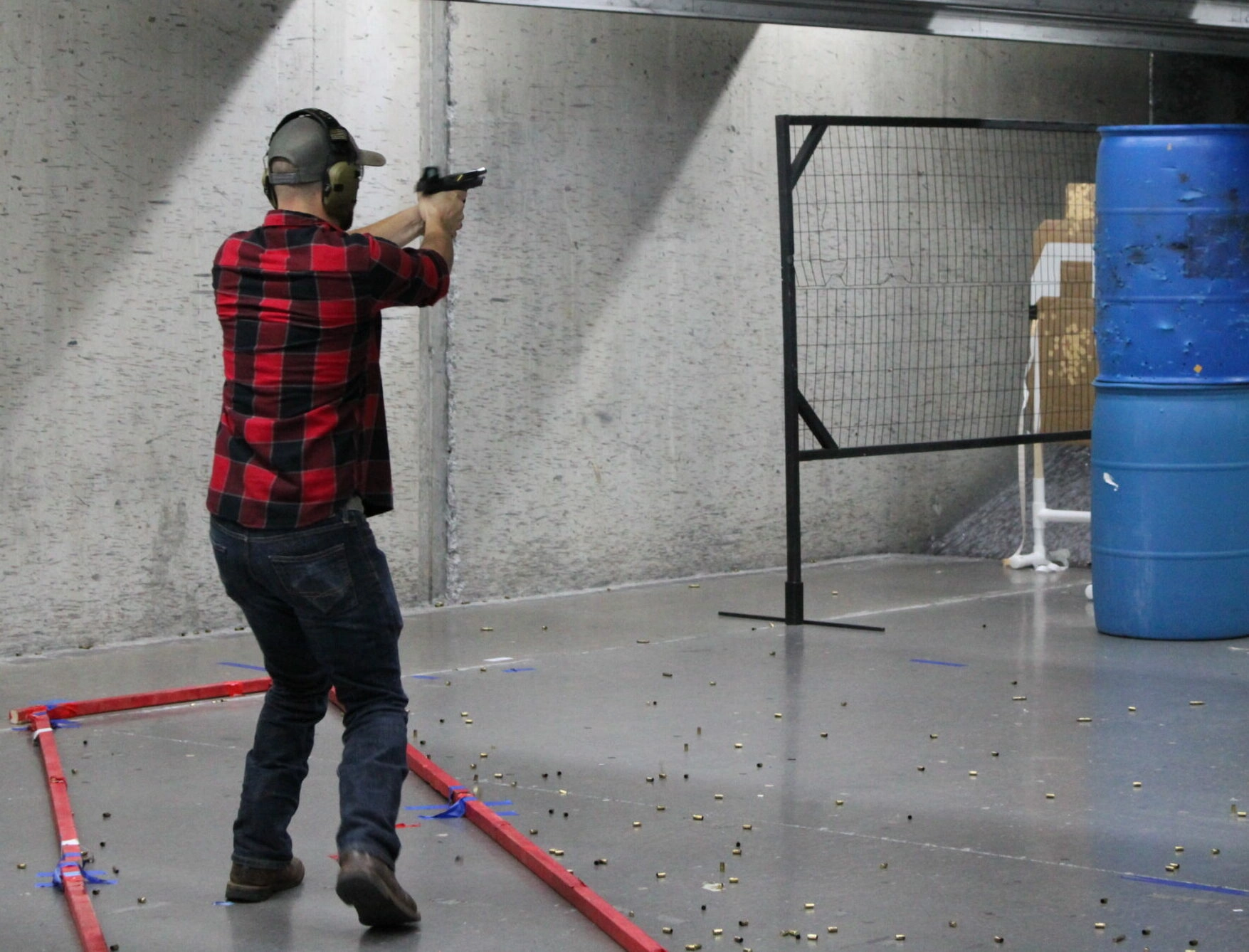
Live fire training remains the gold standard. Under realistic conditions — with recoil, noise, and the full sensory experience of a fired round — your body learns to respond to the real thing. Focus each session on specific skills rather than simply putting rounds downrange.
01
Draw & Grip Establishment
Practice your draw from the holster (where range rules allow) and focus on achieving a consistent, repeatable grip every single time.
02
Sight Alignment & Trigger Reset
Acquire the front sight instinctively. Work on a smooth trigger reset between shots to maintain accuracy through a string of fire.
03
Magazine Reloads
Practice both speed reloads and tactical reloads. Your hands should find the magazine release and seat a fresh mag without looking down.
04
Malfunction Drills
Train to recognize and clear common malfunctions (tap-rack-reassess) until the response is instinctive rather than panicked.
Quality over quantity. Fifty focused, deliberate rounds build more muscle memory than 200 rounds fired without intention.
Dry Fire Practice at Home
Dry fire practice — working your firearm’s mechanics with an unloaded gun — is one of the most effective, accessible, and underutilized training tools available to civilian shooters in Georgia. It costs nothing but time, and it can produce measurable improvement in weeks.
Dry Fire Safety Protocol — Non-Negotiable
- Remove the magazine completely
- Lock the slide back and visually inspect the chamber
- Physically check the chamber with your finger
- Remove all live ammunition from the room
- Choose a safe backstop direction
- Triple-check before you begin — and check again if interrupted
Once confirmed clear, focus your dry fire sessions on the four pillars that carry over directly to live fire:
Grip consistency — the foundation of accuracy, recoil control, and speed
Trigger control — isolate a smooth, straight-back press with no muzzle movement
Safety manipulation — engage and disengage until it’s automatic in your draw
Magazine drills — drop and seat magazines without looking down
Even 10 to 15 minutes of daily dry fire practice can produce measurable improvements within weeks — making it one of the highest-return habits any firearm owner in the Atlanta area can build.
Visualization & Mental Rehearsal
Elite athletes across every sport use mental rehearsal — and shooters benefit from it too. Walk through your draw, presentation, sight alignment, and trigger press in your mind with vivid detail. This mental repetition reinforces the same neural pathways that physical practice builds, and it costs nothing.
Responsible Firearm Ownership Is a Community Commitment
Personal proficiency with a firearm isn’t just about your own safety. It’s a contribution to the safety of everyone around you — your family, your neighbors, and your community across Kennesaw, Marietta, Acworth, and the broader Metro Atlanta area.
When firearm owners train consistently, proper storage habits become second nature. Safe handling in public spaces, at ranges, during transport, and in parking lots becomes instinctive. The risk of accidents drops significantly when fundamentals are deeply practiced rather than vaguely remembered.
“Every responsible gun owner who trains seriously is an asset to their family, their neighbors, and their community.”
Responsible ownership also means understanding the legal and ethical dimensions of carrying and self-defense — and knowing when not to draw. That judgment is sharpened by training too. The more automatic your mechanics become, the more clearly your mind can evaluate a situation and recognize when de-escalation is the wiser call.
The Real Payoff: Freedom of Mind When It Matters Most
When your mechanics are automatic, something meaningful happens: your conscious mind is freed. Instead of thinking about where your safety is or whether your grip is correct, your full mental bandwidth is available for situational awareness — reading your environment, assessing threats, and making decisions.
In a self-defense scenario, that cognitive clarity is not a luxury. It’s a lifeline. This is precisely why law enforcement officers, military personnel, and competitive shooters train their mechanics relentlessly. It’s not about a fast draw. It’s about ensuring that when the moment demands action, the body knows exactly what to do — without the mind having to interrupt and explain it.
Train With Purpose at Governors Gun Club in Kennesaw, GA
Building real, reliable muscle memory is not something you should leave to chance — or figure out alone. Proper technique established early and reinforced consistently prevents bad habits from becoming deeply encoded. Bad muscle memory is harder to unlearn than good habits are to build from the start.
At Governors Gun Club in Kennesaw, Georgia, our certified instructors work with shooters across the Atlanta metro — from Marietta and Smyrna to Acworth, Woodstock, and Canton — at every experience level.
Firearm safety & fundamentals classes for new and experienced shooters
One-on-one personal training tailored to your specific firearm and goals
State-of-the-art range facilities for consistent, structured live fire practice
Safe, welcoming environment for shooters of all backgrounds and skill levels
Consistent practice is what separates a confident, capable shooter from one who merely owns a firearm.
Governors Gun Club — Train Smart. Stay Safe. Stay Ready.